I. Product Positioning
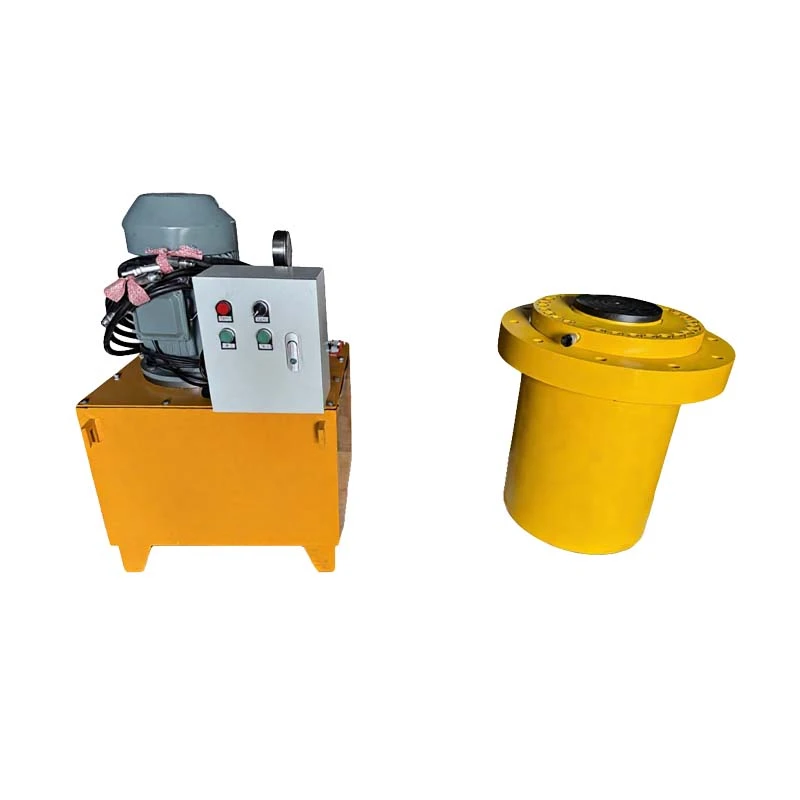
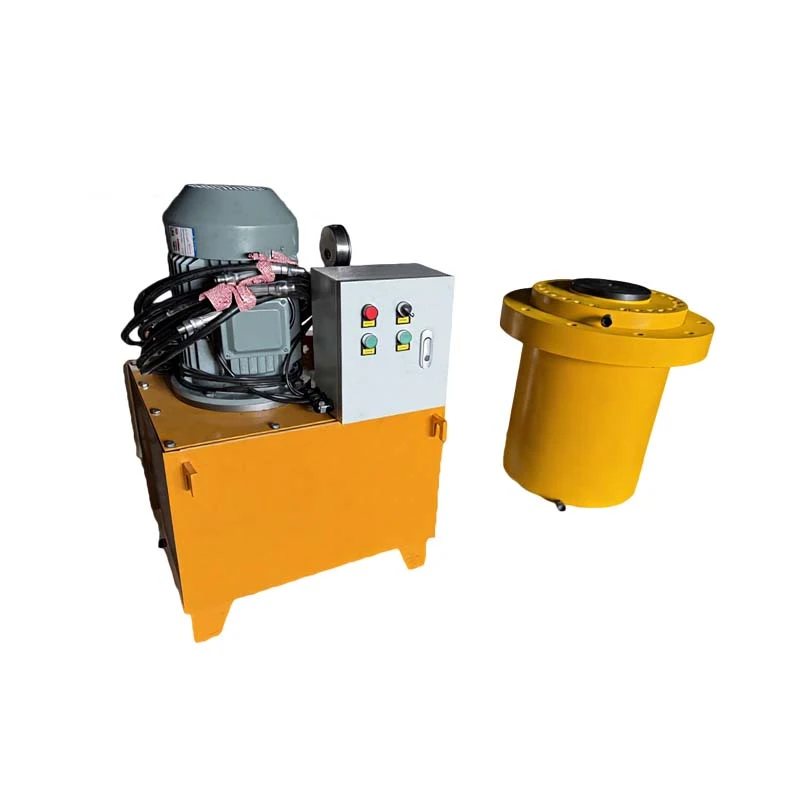
This heavy-duty hydraulic cylinder adopts a front flange fixed installation method, which uses the flange plane as the main load-bearing and fixing base. It functions as a stationary high-power hydraulic execution unit on construction sites. In actual engineering work, it is commonly used for structural jacking, routine prestressing construction, mechanical component press fitting, as well as bridge bearing jacking and position correction, covering most fixed-point high-load hydraulic operation scenarios.
II. Main Structural Features
Integrated Flange Fixing Structure
The widened top flange is pre-drilled with a full circle of bolt holes, allowing direct bolt fastening on equipment bases, embedded concrete parts or steel frame structures. After installation, the cylinder will not slide or tilt under heavy load, which is very suitable for long-term fixed-point pressurization and jacking work. The flange design can well disperse the reaction force generated during operation, avoid local stress concentration on the cylinder body, and adapt to various high-tonnage and long-duration load working conditions.
Cylinder Mechanical Structure Design
The cylinder adopts a short and thick overall structure, which delivers much higher overall rigidity and lateral force resistance than ordinary slender hydraulic jacks. The structural deformation is extremely small after pressurization, so the jacking state remains stable and the operation precision is guaranteed. The top plunger is designed with a solid load-bearing surface, which can be matched with auxiliary pressure-bearing plates on site to further ensure uniform force transmission during jacking and pressing work.
Hydraulic System Configuration
The product is available in single-acting and double-acting versions to meet different construction needs. The single-acting type relies on hydraulic pressure for jacking, and resets through spring force or gravity. The double-acting type uses hydraulic power for both extension and retraction. For high-tonnage working conditions, the double-acting model is more practical, as it realizes precise and controllable return stroke and effectively improves overall construction stability.
III. Operational Performance, Advantages and Limitations
Product Advantages
With bolted flange fixing, the cylinder requires no additional lateral limit protection after installation. It can cope with long-term pressure holding and frequent cyclic loading tasks, effectively solving the problems of displacement and slipping that often occur with ordinary movable jacks. The product supports a wide range of tonnage from several hundred tons to thousands of tons, fully meeting the construction demands of large component jacking, integral bridge lifting and pile foundation static compression testing. Thanks to its short-stroke compact structure, the cylinder can be installed and used normally in spaces with limited vertical height while providing super high jacking force.
In terms of durability, the outer cylinder is sprayed with standard industrial yellow anti-corrosion paint. The inner wall is precisely machined and equipped with high wear-resistant sealing parts, which can adapt to long-term open-air and complex construction site environments and reduce later maintenance frequency.
Product Limitations
Since the cylinder depends on flange bolts for fixed installation, it cannot be moved freely like portable jacks, resulting in poor flexibility and mobility on site. In addition, limited by its short-stroke design, it is not applicable for engineering operations requiring long-distance lifting or large-stroke tensioning, and is only suitable for fixed-point jacking and pressurization scenarios.
IV. Typical Application Scenarios
This flange-mounted hydraulic cylinder is widely used in bridge bearing replacement and integral beam lifting and deviation correction. It serves as the main power equipment for reaction loading in pile foundation static load tests. It is also commonly used for press fitting construction of large steel components and precise pressurization calibration of prestressed parts. Besides, it can form a multi-point synchronous jacking system to complete fixed-point lifting and structural adjustment for foundation pits and various building structures.