I. Structural Design Characteristics
Front Direct Clamping Structure
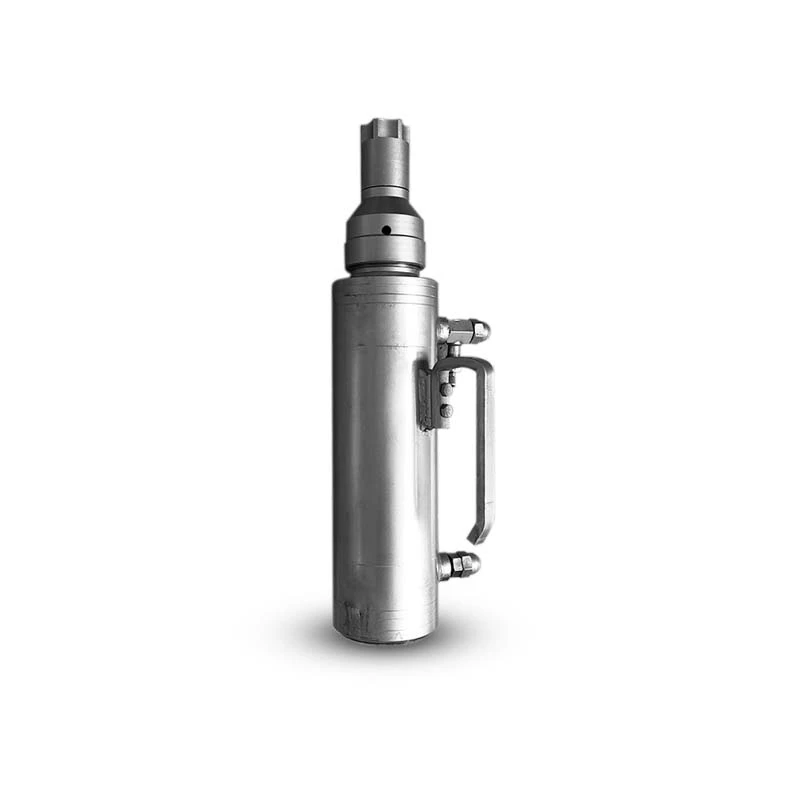
The clamping and tensioning assembly is arranged on the front end of the cylinder body, which can directly clamp single steel strand for tensioning work. This design removes the need for matching auxiliary anchors and limit plates used in traditional tensioning tools. It greatly cuts down on-site assembly procedures and pre-construction preparation work. The highly integrated clamping head simplifies the overall structure and keeps the whole equipment compact and neat.
Portable Lightweight Body Design
Fitted with an integral carrying handle, the equipment features a lightweight overall structure. A single operator can finish carrying, positioning and full tensioning operation independently, with no need for crane or other lifting auxiliary equipment. It adapts well to complex construction environments with limited operating space, including narrow gaps at beam ends, foundation pit slope surfaces and cramped high-altitude working areas.
Dual-Circuit Double-Acting Hydraulic Configuration
Two independent oil ports are configured on the equipment, separately controlling cylinder extension for tensioning and retraction for anchor releasing. The hydraulic system builds up pressure steadily and maintains pressure stably during operation. After pressure relief, the cylinder can automatically retract hydraulically, making anchor releasing smooth and labor-free. The tool is fully compatible with conventional electric hydraulic pumps used on most construction sites.
Short-Stroke High-Precision Cylinder
The cylinder adopts a short effective stroke design, which is specially optimized for single-strand formal tensioning, pre-tensioning and secondary re-tensioning operations. The internal sealing structure is compact and reasonably arranged, effectively preventing oil leakage failures even under long-term high-pressure working conditions, ensuring stable and reliable equipment operation.
II. On-Site Construction Advantages
Accurate Independent Single-Strand Tensioning
This equipment supports tensioning one single steel strand at a time, instead of overall bundled tensioning. In actual construction, workers can perform individual pre-tensioning and stress leveling for each strand in a bundle, conduct post-tensioning stress inspection, and carry out targeted supplementary tensioning for under-stressed strands. It effectively solves the problem of uneven stress distribution among bundled steel strands and realizes accurate and controllable tensioning quality.
Flexible Movement and High Construction Efficiency
The tool requires no repeated installation of auxiliary anchoring parts during use, with simple assembly and disassembly. It is extremely suitable for discrete and multi-point tensioning work on construction sites. Common applicable working conditions include foundation pit anchor cable tensioning, supplementary tensioning of unbonded prestressed tendons on basement slabs, and prestressed tensioning for small precast structural components.
Low Requirement for Strand Exposure Length
Benefiting from the front-end direct clamping mode, the equipment only needs a short exposed steel strand length to complete clamping and tensioning. It reduces the leftover strand length after construction, lowers raw material waste, and is especially applicable to working scenarios where the anchorage end has reserved space limitations.
III. Application Scope and Product Limitations
Suitable Engineering Scenarios
It is applicable to independent tensioning of anchor cables for slope reinforcement and foundation pit support. It can complete single-strand pre-tensioning and fine stress adjustment before integral tensioning of large strand bundles, ensuring balanced stress of the whole bundle. The tool also supports re-tensioning construction and real-time stress monitoring for completed prestressed components, and is the preferred equipment for discrete tensioning operations in narrow spaces and high-altitude positions.
Product Performance Limitations
This tool is only designed for single-strand independent tensioning and cannot realize synchronous tensioning of entire steel strand bundles, so it is not applicable for high-tonnage main beam prestressed tensioning of bridge projects. With a rated tonnage of 25t or 30t, it belongs to small and medium-tonnage tensioning equipment and cannot meet the load requirements of large-tonnage bundled strand tensioning operations.