content_lane: evergreen_cluster
url_action: new
language: en
hreflang: en
alternate_zh_cn: /blog/post-tensioning-stressing-inspection-guide/
seo_title: Post-Tensioning Stressing and Inspection Guide
h1: Post-Tensioning Stressing and Inspection: Building a Traceable Quality-Control Loop
slug: /en/blog/post-tensioning-stressing-inspection-guide/
primary_keyword: post-tensioning stressing procedure
secondary_keywords:
- post-tensioning inspection
- tendon elongation measurement
- stressing jack calibration
- concrete strength before stressing
- post-tension stressing report
search_intent: Construction quality control, acceptance, and investigation of stressing discrepancies
article_type: Construction procedure and inspection guide
meta_description: Review the post-tensioning stressing procedure from concrete release and jack calibration to elongation checks, discrepancy review, and final records.
schema_recommendation: BlogPosting; markup must match the visible author, publication date, and modification date
last_updated: 2026-08-25
Post-Tensioning Stressing and Inspection: Building a Traceable Quality-Control Loop
Direct answer: A post-tensioning stressing operation is not accepted solely because the concrete is a certain number of days old or the pump reaches a target pressure. A traceable acceptance process should show that the specified concrete condition was verified, the jack and gauge calibration is valid, the approved stressing sequence was followed, pressure and measured elongation were recorded, anchorage behavior was checked, and discrepancies were reviewed by the responsible design professional.
Tendon tails should not be cut and anchorage pockets should not be closed until the required review is complete.
Recent Reddit discussions repeatedly ask whether stressing can begin on a particular day, whether target pressure proves completion, and whether late stressing corrects an earlier omission. The questions point to the same lesson: stressing is an evidence chain, not one hydraulic action.
What Is Post-Tensioning Stressing?
In post-tensioning, prestressing force is applied after the concrete has reached a specified condition. ACI defines the method as prestressing in which tendons are tensioned after the concrete attains a specified minimum strength or minimum age. ACI: Post-Tension in Concrete
The word “specified” is critical. A typical age may help schedule testing, but it does not replace the project’s release criterion. Concrete mixture, curing temperature, member type, staged-stressing plan, and design requirements can all affect the timing.
An ACI discussion of the 2024 International Building Code inspection provisions states that in-place concrete strength is to be verified before tendons in post-tensioned concrete are stressed. ACI Concrete Q&A, 2026
What Reddit Discussions Reveal About Field Acceptance
Why measure elongation if the jack reached pressure?
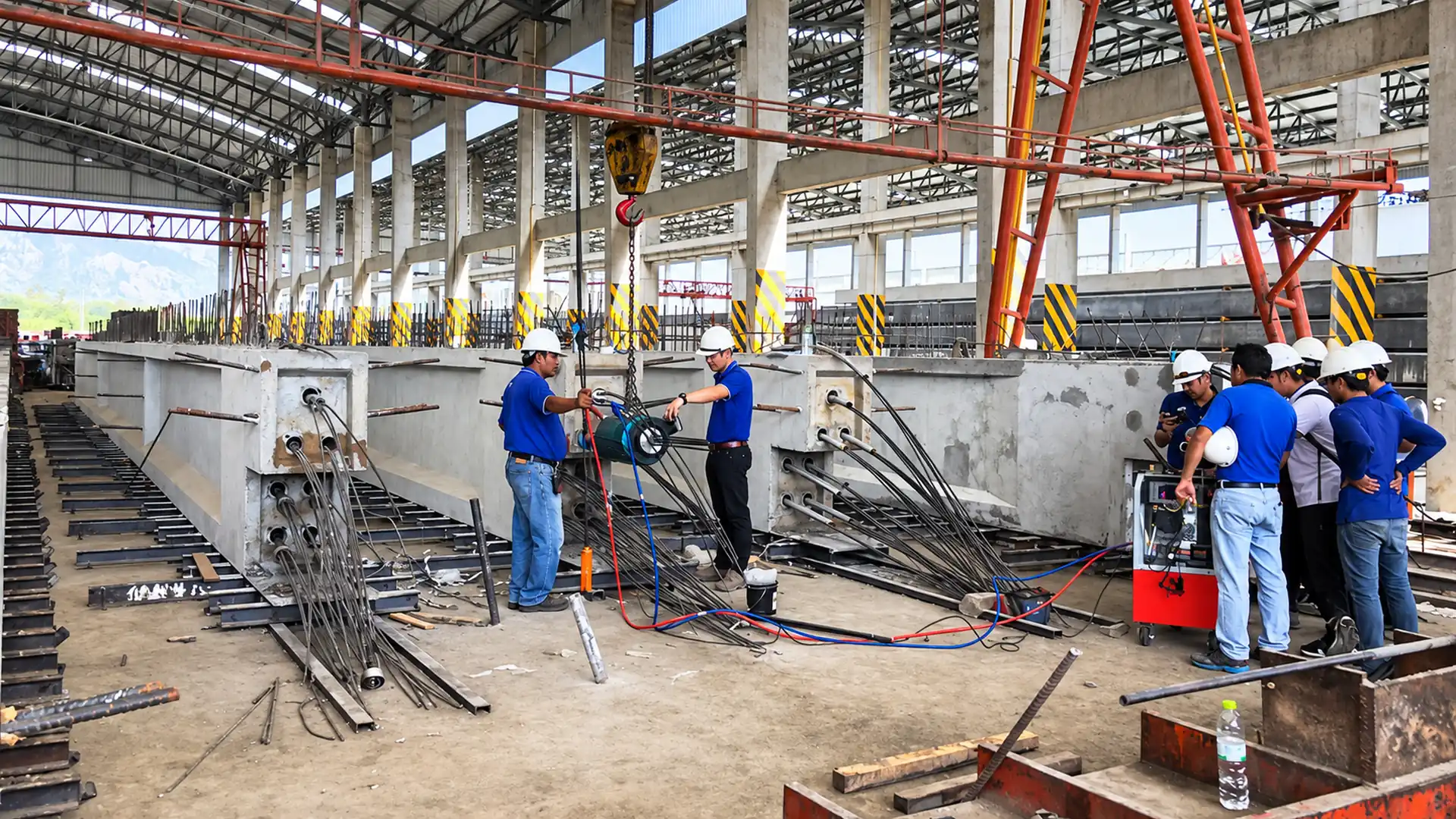
In a discussion showing a post-tensioning jack in operation, contributors explained tendon marking, wedge anchorage, and elongation measurement. Gauge pressure describes the hydraulic input through a calibration relationship. Measured elongation provides a separate observation of tendon response.
Neither is a complete test by itself. Used with the theoretical elongation, equipment calibration, and field observations, the two measurements can help reveal a missed tendon, unusual friction, wedge movement, reading error, or equipment problem.
PTI’s field elongation FAQ makes the same caution explicit: elongation measurement is not a perfect standalone verification method. Correct calibration, functioning equipment, consistent measurement, and accurate records all matter. PTI FAQ No. 6: Field Elongation Measurements
Why a restressing video is not a universal first-stressing procedure
A discussion about restressing an exposed tendon shows a condition in which the tendon tail had already been treated and later exposed. The operation may relate to a missed tendon, an unresolved stressing record, or a repair. It should not be copied as a standard initial-stressing sequence.
Before corrective stressing, the team may need to re-establish the tendon identity, original force history, anchorage condition, concrete condition, and previous records. The required procedure belongs to the specific system and the engineer’s direction.
Does late stressing restore the original construction sequence?
In a discussion about tendons left unstressed for almost 28 days, construction loads had already been placed and cracking had appeared. Later stressing may close some cracks, but it cannot automatically erase the member’s earlier load history, permanent deformation, damage, or documentation gap.
The design professional should consider actual loads, temporary support, measured concrete condition, crack records, anchorage condition, and the proposed stressing sequence before deciding whether work may continue.
Nine Control Points for Stressing and Acceptance
Pressure and elongation have acceptance value only when they are tied to the same tendon, equipment set, calibration curve, and approved design data.
| Control point | What to verify in the field | Minimum record | Common red flag |
|---|---|---|---|
| 1. Document control | Approved PT drawings, sequence, theoretical elongations, and revisions | Current document register | An old drawing or verbal target is used |
| 2. Tendon and anchorage condition | Tendon, anchorage, wedges, and end-zone details match the approved system | Material and pre-stressing inspection record | Contamination, damage, or concrete defects remain unresolved |
| 3. Concrete release | The specified strength or other release condition has been verified by an accepted method | Test report and release authorization | Release is based only on age or habit |
| 4. Equipment calibration | Jack, gauge, hoses, serial numbers, and calibration curve form the approved set | Valid calibration documentation | Field serial numbers do not match the certificate |
| 5. Safety preparation | Exclusion zone, operator position, equipment check, and emergency actions are clear | Pre-task check or permit | Personnel stand in a potential tendon or anchorage release path |
| 6. Initial condition | Tendon marks, slack-removal method, and measurement reference are consistent | Initial readings and photographs | Thick marks, changing reference points, or inconsistent readers |
| 7. Stressing execution | Load is applied in the approved sequence and pressure is recorded by tendon | Tendon-by-tendon field record | Skipped tendons, sequence changes, or unapproved force increases |
| 8. Elongation and anchoring | Measured elongation, wedge seating, and tendon behavior are compared with project criteria | Comparison sheet and discrepancy list | A single “complete” entry replaces individual data |
| 9. Review and closeout | Discrepancies receive timely written disposition | Approved stressing report | Tails are cut or pockets patched before approval |
This nine-point checklist is an editorial framework based on published information. It is not an industry standard. The contract documents, design drawings, applicable code, and project specifications take precedence.
Concrete Release: Why a Fixed Number of Days Is Not Enough
Early concrete strength is affected by materials, temperature, curing, and member conditions. Two placements made on the same day do not necessarily reach the required condition at the same time.
A useful release record should state:
- The specified release condition;
- The accepted verification method;
- Which placement or slab area the test represents;
- The test result and date;
- Who authorized stressing to begin.
“It has been three days” or “the previous floor was stressed at this age” is not a complete evidence trail. Time can trigger testing. It should not replace the result and release authorization.
Jack and Gauge Calibration: The Date Is Only One Check
The calibration documentation should identify the jack-and-gauge combination used in the field and include the serial numbers and applicable calibration relationship. PTI’s current certification criteria for plants producing unbonded single-strand tendons require jacks and gauges to be calibrated as a unit at intervals not exceeding six months. The document also states that project-specific requirements may call for more frequent calibration. PTI-CRT-20 G1, Section 3.3.3, 2026
That interval should not be treated as permission to ignore equipment condition. Impact, repair, replacement of a component, or an abnormal reading may trigger additional review under the applicable procedure. The team must also use the curve for the actual equipment set—not a generic chart for the same model.
How Pressure and Elongation Cross-Check Each Other
Gauge pressure is converted to jack force through the calibration relationship. Theoretical elongation comes from the tendon length, material properties, profile, friction assumptions, and design calculations. Measured elongation records the field response.
These values are complementary. If they disagree, do not increase pressure simply to make one number match. First check the tendon identification, starting reference, marks, wedge seating, equipment function, profile, friction assumptions, and transcription.
PTI’s resource entry for The Stressing Report states that exposed tendon tails should remain uncut and anchorage recesses should remain unpatched until the elongations have been approved by the design professional. PTI Resource Library: The Stressing Report
Go/No-Go Review for Stressing Results
Continue under the approved procedure when
- The concrete release, document version, and equipment calibration are valid;
- Pressure and elongation records are complete and meet the project criteria;
- Wedges, anchorages, and end-zone concrete show no unresolved abnormality;
- No new crack, spall, unusual sound, or equipment fault has appeared;
- All required reviews and hold-point releases have been completed.
Pause and investigate when
- Measured elongation differs from the theoretical value and the initial check does not explain it;
- Pressure reaches the target but elongation is abnormal, or elongation appears reasonable but calibration is invalid;
- A tendon tail, wedge, anchorage, or end-zone concrete is damaged;
- A tendon is missing, unstressed, or stressed out of sequence;
- Tails have been cut, pockets closed, or significant construction loads added before approval;
- A sudden pressure loss, loud report, excessive movement, or safety event occurs.
After a pause, the design professional may require remeasurement, approved restressing, tendon replacement, strengthening, revised acceptance, or a broader structural evaluation. The stressing crew should not resolve unexplained discrepancies by applying extra force on its own.
What a Reviewable Stressing Report Should Contain
A stressing report should allow a person who was not present to reconstruct what happened: which placement, which tendon, which equipment, which data revision, which readings, which anomalies, and which approval.
The report should address at least:
- Project, level or placement, and stressing date;
- Contractor, operator, and inspector identification;
- Concrete release basis;
- Jack and gauge serial numbers, calibration certificate, and applicable curve;
- Tendon number, theoretical elongation, pressure reading, measured elongation, and anchorage observation;
- Missed tendons, broken tendons, abnormal friction, or equipment faults;
- Written disposition of discrepancies;
- Review status and the date when tail cutting and pocket closure were authorized.
Key Takeaways
- Release depends on verified project criteria, not a universal day count: Age can schedule a test but cannot replace the required evidence.
- Pressure and elongation must be cross-checked: Neither measurement independently proves successful stressing.
- Equipment identity must be traceable: The field jack, gauge, serial numbers, certificate, and calibration curve must match.
- Discrepancies are investigated, not forced into compliance: Pause, identify the cause, and obtain written engineering direction.
- Report approval is a hold point: Keep tendon tails and anchorage pockets accessible until the required elongation review is complete.
Frequently Asked Questions
How many days after concrete placement can post-tensioning begin?
There is no universal day count. Stressing should begin after the strength or other release condition specified in the project documents has been verified by an accepted method. Concrete mixture, curing, and temperature affect when that condition is reached.
Does reaching the target gauge pressure mean the tendon is accepted?
No. The calibration relationship, measured elongation, wedge and anchorage behavior, stressing sequence, and tendon-specific record also need to be checked.
Can the operator pull harder when measured elongation is low?
Not without an approved instruction. First review the measurement, tendon number, equipment, wedges, friction, and records. The design professional should determine the response under the project requirements.
How often should a stressing jack and gauge be calibrated?
Follow the project specifications and applicable certification requirements. PTI’s current criteria provide a clear six-month maximum interval for the jack-and-gauge unit in the cited certification context and recognize that a project may require a shorter interval. Damage, repair, or abnormal readings may justify an earlier check.
Does delayed stressing become acceptable once the tendons are finally stressed?
Not automatically. Loads applied during the delay, cracking, deformation, shoring, concrete condition, and anchorage status should be evaluated. Later stressing cannot erase the member’s previous load history.
Reviewing a Stressing Placement?
Put the approved drawings, concrete release record, equipment calibration, and tendon-by-tendon field data in one review package. Identify missing tendon numbers, mismatched equipment serials, and unresolved discrepancies before authorizing tail cutting and pocket closure.
Complete the Stressing Review Package →
About This Guide
This article was compiled from field questions in public Reddit discussions from the past five years and published PTI and ACI materials. Reddit content is used to identify recurring misconceptions. No unpublished first-party data or project-specific stressing parameters were used. The article has not been independently reviewed by a licensed structural engineer. Project acceptance must follow the approved design documents, specifications, applicable code, and written direction of qualified professionals.
References & Sources
- FAQ No. 6: Field Elongation Measurements — Post-Tensioning Institute
- PTI-CRT-20 G1: Certification of Plants Producing Unbonded Single Strand Tendons, Section 3.3.3, 2026 — Post-Tensioning Institute
- The Stressing Report — Post-Tensioning Institute Resource Library
- Post-Tension in Concrete — American Concrete Institute
- Concrete Q&A, January 2026 — American Concrete Institute
Related Articles
- Can You Drill or Cut a Post-Tensioned Slab? — Put scanning, engineering approval, and strike response ahead of alteration work.
- Cracks, PT Coating Leakage, and Anchorage Distress in Post-Tensioned Slabs — Identify service-life signals related to delayed stressing, water intrusion, sheathing, and anchorages.